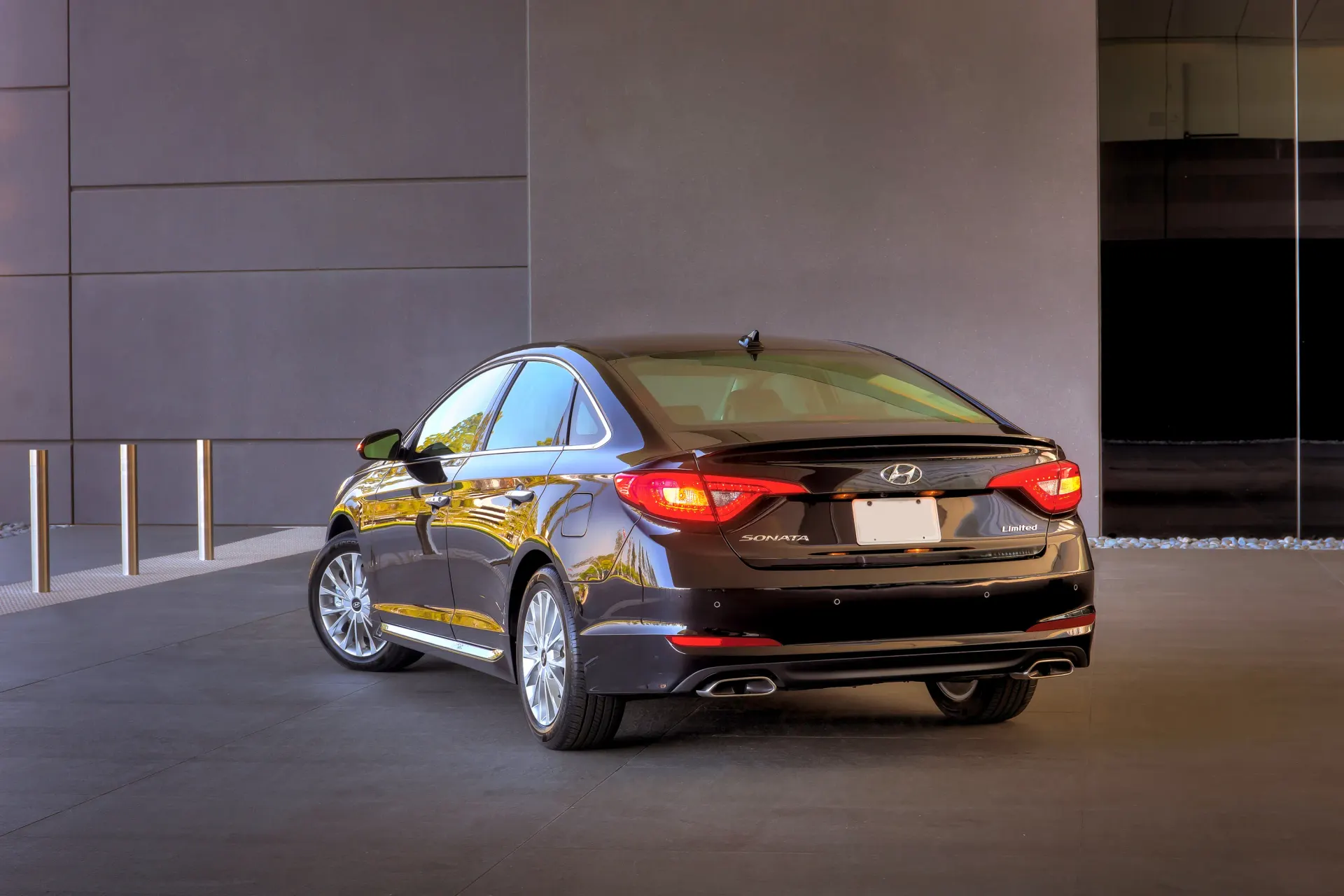
Hyundai Sonata 2016–2019
Source: carbuzz.com
The two hold about the same at most: 16.3 cu ft for the Hyundai Sonata (2016 Hyundai Sonata 2.4L Limited) and 15.9 cu ft for the Kia Optima.
Source: carbuzz.com
Both side profiles drawn at the same scale, standing on the same ground line. Switch to the overlay to lay one over the other, and choose what they line up on.
Both drawings use one scale: the grid lines are 1 ft50 cm apart, measured from the rear bumper. We don't have the exterior length of the Hyundai Sonata 2016–2019 or the Kia Optima 2016–2020 yet, so their sizes are estimated from a typical car of the same class; cargo spaces are drawn at their measured size. No outline has been traced for the Kia Optima 2016–2020; a typical shape for the class stands in.
Each car's measured spaces, drawn on its own outline. Hover or tap a shaded space for every measurement.
Trunk Space
Vol 16.3 cu ft
Trunk Space
Vol 462 L
Standard gasoline
Vol 15.9 cu ft
Standard gasoline
Vol 450 L
The better figure in each row is marked Better: more space, a bigger opening, a lower lift-over.
| Hyundai Sonata 2016–2019 2016 Hyundai Sonata 2.4L Limited (1 of 4 layouts) | Kia Optima 2016–2020 | |
|---|---|---|
| Cargo volume | ||
| Most cargo space | 16.3 cu ft462 LBetter | 15.9 cu ft450 L |
| Behind the rear seats | 16.3 cu ft462 LBetter | 15.9 cu ft450 L |
| Load space (Trunk Space) | ||
| Space measured | Trunk Space | Standard gasoline |
| The car | ||
| VE score | VE 74Better | VE 73 |
| Class | Large cars | Large cars |
| Best combined MPGe | 42 MPGe | 42 MPGe |
Full figures and owner fit reports: Hyundai Sonata 2016–2019, Kia Optima 2016–2020.