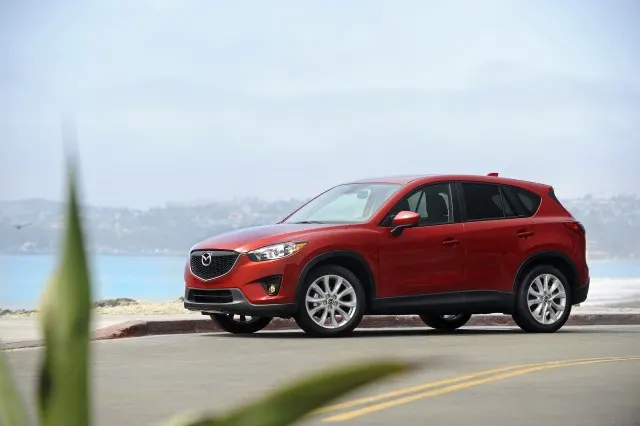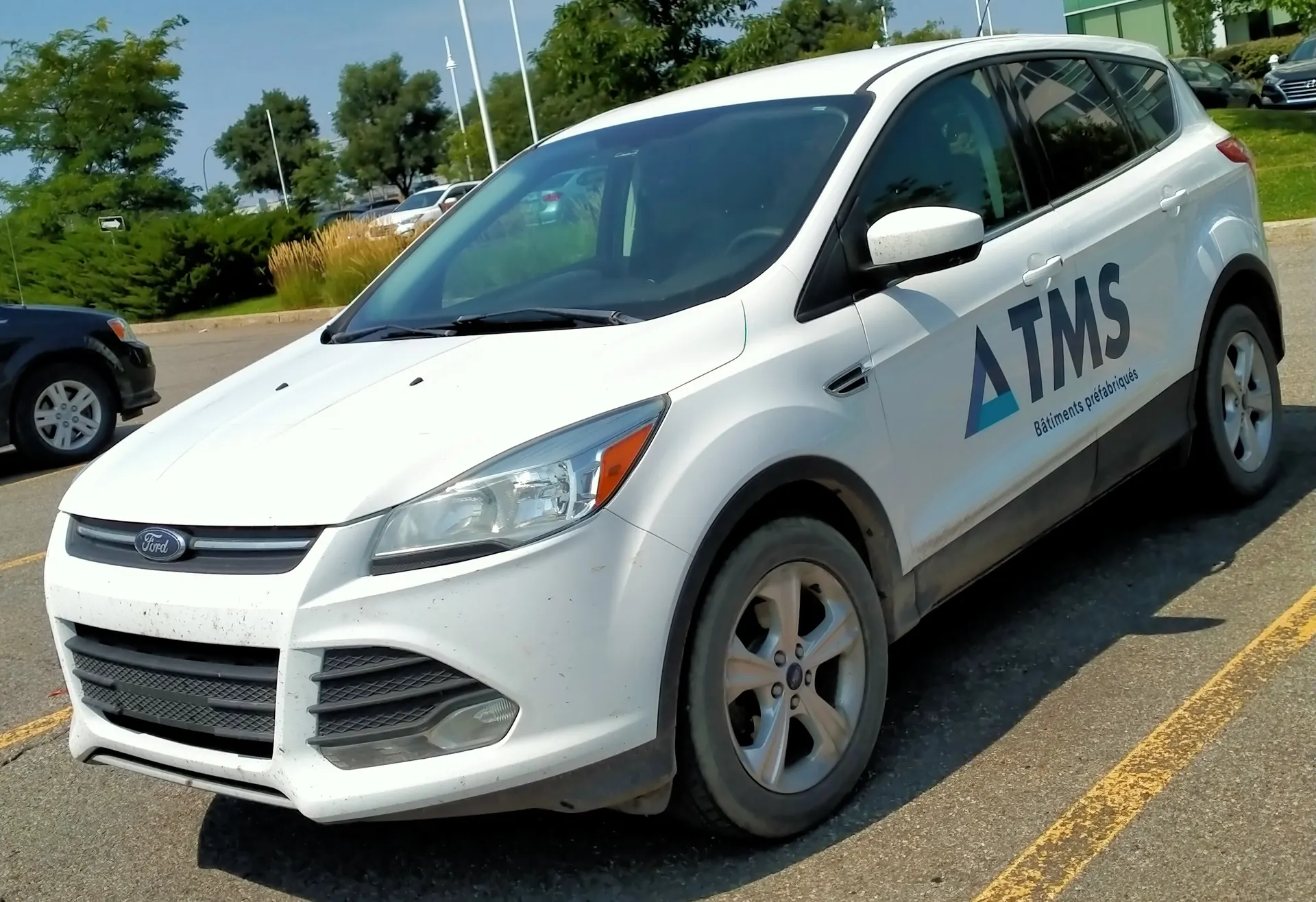
Ford Escape 2013–2019
Source: commons.wikimedia.org
The Ford Escape has more room: 68.0 cu ft at most against 64.8 cu ft for the Mazda CX-5 (Sport), about 5% more.
Source: commons.wikimedia.org
Courtesy of Mazda North American Operations
Both side profiles drawn at the same scale, standing on the same ground line. Switch to the overlay to lay one over the other, and choose what they line up on.
Both drawings use one scale: the grid lines are 1 ft50 cm apart, measured from the rear bumper. We don't have the exterior length of the Ford Escape 2013–2019 or the Mazda CX-5 2013–2016 yet, so their sizes are estimated from a typical car of the same class; cargo spaces are drawn at their measured size. No outline has been traced for the Ford Escape 2013–2019 or the Mazda CX-5 2013–2016; a typical shape for the class stands in.
Each car's measured spaces, drawn on its own outline. Hover or tap a shaded space for every measurement.
Cargo behind rear seats
Vol 34.3 cu ft
Cargo behind rear seats
Vol 972 L
Maximum cargo with rear seats folded
Vol 68.0 cu ft
Maximum cargo with rear seats folded
Vol 1,925 L
Behind second row
D 38.7 inW 57.1 inH 34.6 inVol 34.1 cu ft
Behind second row
D 98 cmW 145 cmH 88 cmVol 965 L
Sport (60/40 split)
Vol 64.8 cu ft
Sport (60/40 split)
Vol 1,836 L
The better figure in each row is marked Better: more space, a bigger opening, a lower lift-over.
| Ford Escape 2013–2019 | Mazda CX-5 2013–2016 Sport (1 of 2 layouts) | |
|---|---|---|
| Cargo volume | ||
| Most cargo space | 68.0 cu ft1,925 LBetter | 64.8 cu ft1,836 L |
| Behind the rear seats | 34.3 cu ft972 L | 34.1 cu ft965 L |
| Rear seats folded | 68.0 cu ft1,925 LBetter | 64.8 cu ft1,836 L |
| Load space (Maximum cargo with rear seats folded) | ||
| Space measured | Maximum cargo with rear seats folded | Sport (60/40 split) |
| The car | ||
| VE score | VE 49 | VE 54Better |
| Class | Small SUVs | Small SUVs |
| Best combined MPGe | 26 MPGe | 29 MPGeBetter |
Full figures and owner fit reports: Ford Escape 2013–2019, Mazda CX-5 2013–2016.